

Our Approach to Sustainability
We regularly evaluate ways to reduce the impact of our operations and products on the environment.
Our commitment to carbon emission reduction
At Tradeprint, we follow a science-based approach to decarbonisation, aligned with a 1.5°C target pathway and the GHG Protocol methodology for Corporate Carbon Footprint. We measure and report on Scope 1, Scope 2, and Scope 3 emissions, including supplier-specific Product Carbon Footprints for key inputs such as paper, other printing substrates, and logistics.
We also track the carbon intensity of our transportation network and our paper purchases, enabling us to focus reductions where they matter most. This data-led approach informs our goal to achieve a 53% reduction in our carbon footprint by FY30 from an FY19 baseline, across all scopes, as a key milestone on our realistic pathway to Net Zero by 2040.
Currently, around 37% of our energy is sourced from renewable sources including biomass, wind, hydro, and solar power. We are working to increase this share through direct investment in energy-reducing infrastructure, process optimisation, and renewable energy procurement.
We are beginning to work more closely with our suppliers to lower the carbon intensity of raw materials, especially paper and inks, and are exploring partnerships with lower-emission carriers to reduce the footprint of our deliveries. Because most emissions in the print industry come from purchased raw materials and logistics, these will remain at the heart of our decarbonisation strategy.
Importantly, we do not rely on carbon offsetting. While offsets can play a role, they risk creating a false sense of progress and can shift attention away from making meaningful, measurable reductions in actual emissions. We believe in tangible actions that reduce emissions at source, ensuring genuine progress toward Net Zero.
As part of the Cimpress family, we are committed to outperforming the well-below 2°C aspiration set at the 2015 Paris Climate Accord. We will continue to be transparent about our performance, sharing progress on our Scope 1 and 2 reductions and reporting on Scope 3 in detail, as we deliver on our commitment to a lower-carbon future.

About our journey to Net Zero 2040 target
When starting their carbon journey, most printing companies calculate their Corporate Carbon Footprint using generic database emission factors (Eco Invent, DEFRA, etc.). They will likely use inaccurate activity data, relying on spend or estimations. While this is already a great first step, we could call this the baby stage of carbon footprint.
The next step is to collect specific data that will provide better information on a company's actual carbon footprint, and its trend over time. This is a more time-consuming approach, but much more useful. Data such as the real weight of paper purchased, distance and weight of shipments to calculate logistics emissions, and understanding the disposal method of the company's products in its market, will help draw a clearer picture of the company's footprint and highlight real emissions hot spots. In this stage, we are still in the infancy of carbon footprint.
The teenage of carbon footprint is having supplier's specific information for our scope 3 emissions: What is the carbon footprint of this paper versus that paper, coming from a different paper mill? What is the emission intensity of this carrier versus this other one?
Tradeprint is already in its late teenage years in that regard: Approximately 74% of the total emissions are calculated using supplier’s specific data points, another 13% on spend-based data and 13% from custom data (generic material, waste in operations, product end-of-life) from generic emission factors. This is very important because we are now able to see the impact of our suppliers' decarbonisation efforts on our carbon footprint and soon make decisions based on this. As we design more recyclable products, this will be visible in our carbon footprint, when we reduce production waste, it will also make a dent in our emissions.
Approximately 74% of the total emissions are calculated using supplier's specific data points, and another 26% from the real activity data, but generic emission factors.
Adulthood is still ahead of us: Making purchasing decisions to reduce emissions consistently is hard because oftentimes it will impact profitability. We are currently working on this, trying to define what approach would work for us. But we are already very proud of the journey accomplished so far because without our data quality growing up in the last year as it did, we could not be on the edge of adulthood.
FY40 Target
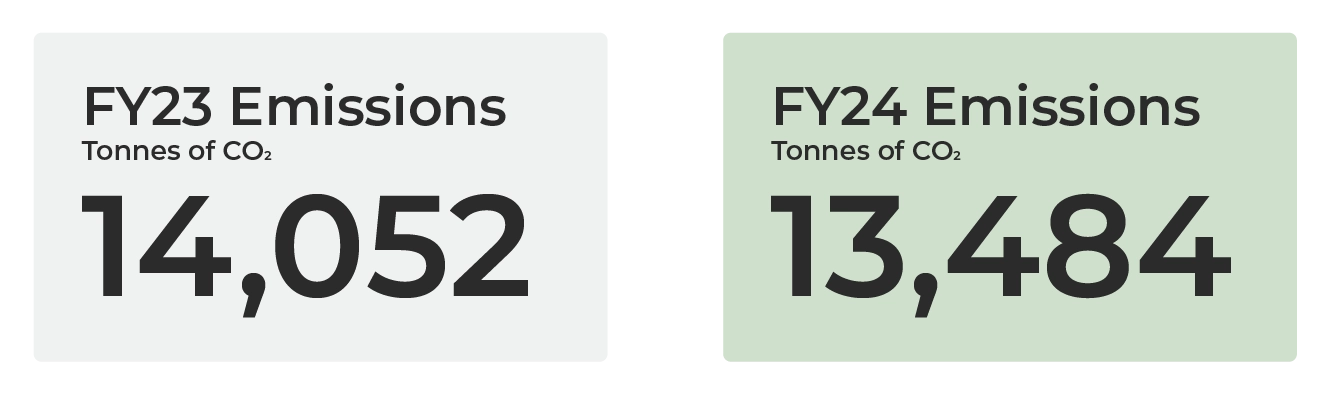
Year on year this represents an almost 5% reduction in our CO2(e) Footprint due in part to gaining improved data points from our shipping partners in particularly DPD and Evri.
Year on Year almost 5% reduction in CO2 (e) representing almost 568 tonnes
Tradeprint's CO2(e) footprint is not assured at Business Unit Level but assured at Cimpress Group level as part of the group's overall footprint. Cimpress ESG Reports
Scope 1 Direct Emissions – Initiatives
Our Scope 1 emissions come from direct, on-site sources such as natural gas used for heating and manufacturing processes, and fuel used in company-owned vehicles. We are actively reducing these through:
Heating Efficiency Upgrades – Replacing older boilers with high-efficiency models, optimising thermostat controls, and improving insulation to reduce natural gas use.
Equipment Optimisation – Upgrading printing and finishing equipment to more energy-efficient models and implementing preventative maintenance programmes to maintain peak efficiency.
Behavioural Energy Management – Training teams on energy-conscious operational practices, including idle-time reduction for equipment shutdown protocols when not in use.
By targeting the sources we control, we’re delivering measurable, year-on-year reductions in our direct emissions, while supporting our broader Science-Based Targets for all scopes.
Scope 2 – Initiatives
Based on the choices available from electricity suppliers we were limited in the ‘green tariff’ energy we could procure but we were able to secure a tariff that includes around 37% of renewable energy.
On-site Renewable Integration (Feasibility) – Assessing opportunities for small-scale solar or heat recovery systems to directly offset Scope 1 fuel demand.
Scope 3 - Initiatives
Paper
We have complete visibility of real time mill data for paper that ensures accuracy of measurement rather than reliance on spend and emissions factor tables.
“Zero waste to landfill” approach
Shipping
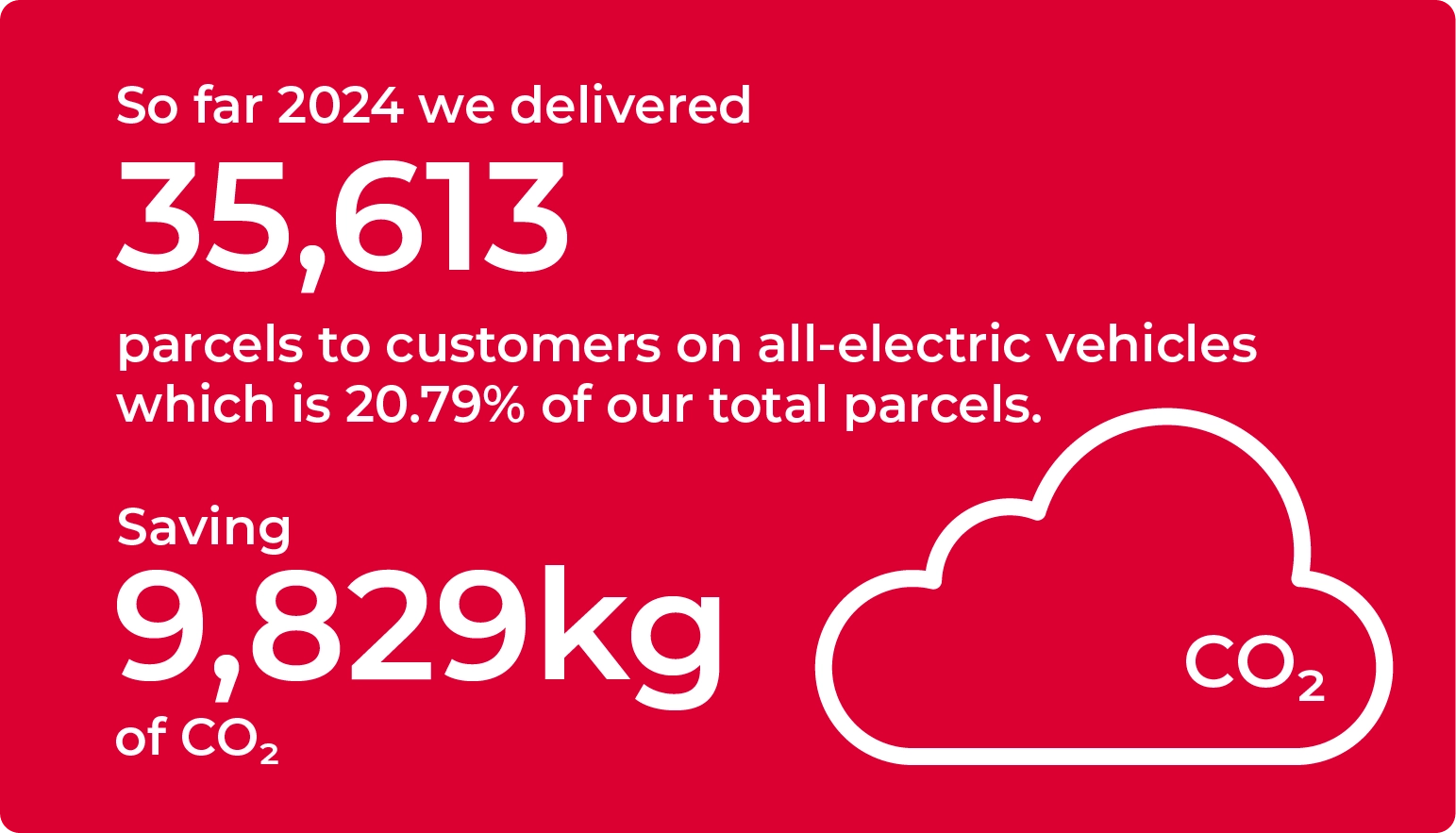
Working closely with our carriers has enabled us to gain more accurate data on actual impacts from Evri and DPD. Our main carrier is DPD, and they have been able to share some exciting reports on impact such as number of parcels delivered via electric vehicles. Around 90% of our volume uses DPD.
Introduction post Covid of Hybrid Working
Our hybrid working model has reduced our Scope 3 emissions from employee commuting by minimising the need for employees to travel to the workplace. Remote work reduces commuting frequency, lowering emissions from personal vehicles and public transport. When on-site presence is required, car share schemes decrease the number of vehicles on the road, cutting emissions per employee, while subsidised public transport encourages greener travel options. Together, these initiatives not only reduce environmental impact but also align with sustainability goals, enhance employee satisfaction through flexibility and cost savings, and bolster our reputation for corporate responsibility.
Supplier Engagement
We continue to educate our Third-Party Fulfillers by sharing our Net Zero ambitions and by supporting them with materials that will help them on their own pathway to Net Zero.
We are working hard to undertake a full assessment of the CO2(e) footprint in our supply chain so we have a better understanding and can identify opportunities to reduce our Scope 3 emissions.








Our Commitment to Responsibly Sourced Paper & Advancing Responsible Forestry
In 2020, we committed to influencing our third-party suppliers to significantly expand their use of responsibly sourced paper for the products they customise on our behalf. Additionally, we are focusing on using packaging materials that contain recycled content from post-consumer sources to help ensure our packaging does not contribute to deforestation. We aim to achieve a 95% conversion to post-consumer waste materials across our third-party supply base and packaging by 2025.
A list of all our FSC® & PEFC-certified products are available upon request. Please contact care@tradeprint.co.uk for details.
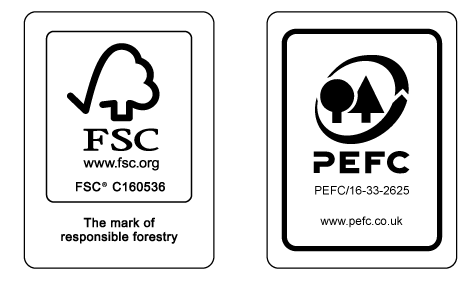
We are officially registered to use both FSC® and PEFC certified papers. Our licence number is FSC-C160536 and PEFC-16-33-2625.
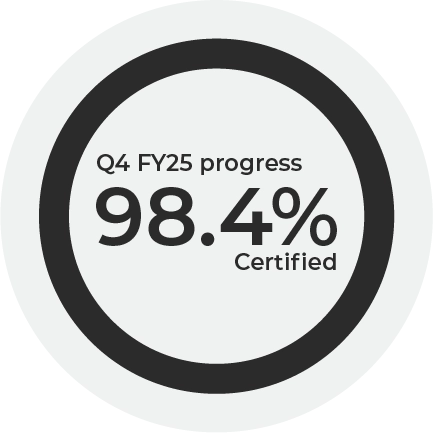
Target of 100% of wood-fibre product spend from FSC® or PEFC™-certified sources. Calculation: FSC® or PEFC™ spend ÷ total spend on wood-fibre products. Q4 FY25 progress: 98.4% certified.
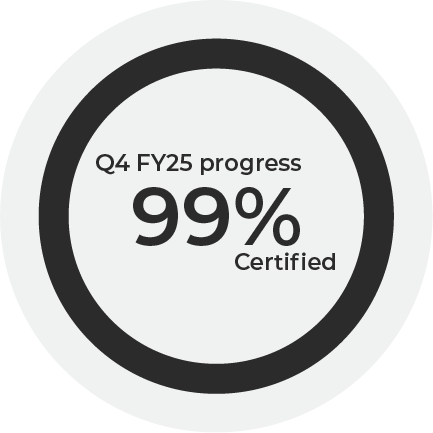
Target of 95% of wood-fibre packaging spend used in Cimpress facilities from FSC®, PEFC™, or post-consumer waste (PCW) materials. Calculation: FSC®, PEFC™ or PCW (Post consumer waste) spend ÷ total spend on wood-fibre packaging. Q4 FY25 progress: 99.1%.
By embedding responsible sourcing into our operations and partnerships, we are helping to safeguard global forests, support sustainable forestry communities, and provide our customers with products that are both high-quality and environmentally responsible.

Our Commitment to Reducing Problematic Plastics & Advancing Circularity
Reducing the environmental impact of plastics is a key priority in Tradeprint’s sustainability strategy. In line with the New Plastics Economy Global Commitment and the EU Plastics Pact, co-sponsored by the UN Environment Programme and the Ellen MacArthur Foundation, we are committed to:
Eliminating 100% of problematic plastics from our operations and supply chain — with a particular focus on PVC and polystyrene.
Ensuring 100% of our packaging is reusable, recyclable at curb side, or compostable.
Reducing virgin plastic use by at least 20%, with at least half of that reduction achieved through overall plastic reduction, and the remainder from increased recycled content.
Prioritising products that are easier to handle at the end of their useful lives and have a lower impact in terms of end-of-life management.
Transition to PVC-Free Products
Our move to PVC-free alternatives is a proactive step toward reducing plastic pollution and anticipating potential future legislation on PVC use. Early information from suppliers suggests this transition could contribute to our wider decarbonisation efforts, in addition to reducing environmental impact. PVC-free substrates are also easier to recycle and manage at end-of-life, helping our customers lower their own environmental footprint.
Waste Management & Circularity
We operate a comprehensive waste management programme in partnership with Reconomy and FESPA UK, achieving industry-leading waste diversion rates through waste separation at source, employee education, and transparent reporting.
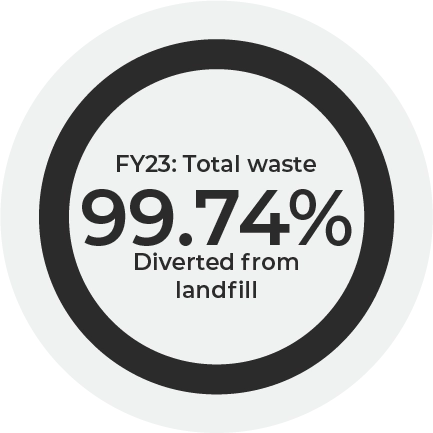
FY23: Total waste = 978 tonnes, of which 2.5 tonnes was landfilled → 99.74% diverted from landfill.
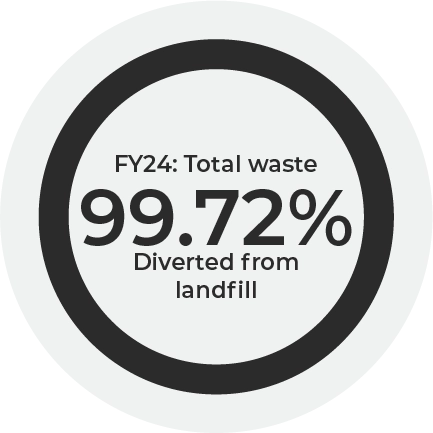
FY24: Total waste = 1,140 tonnes, of which 3 tonnes was landfilled → 99.72% diverted from landfill.
These results demonstrate our commitment to waste minimisation, circularity, and resource efficiency, ensuring that almost all materials are recovered, recycled, or repurposed.
Measurement & Accountability
Problematic Plastic Elimination Target: 0% by weight of problematic plastics (PVC, polystyrene) used in products and packaging.
Calculation Method: Problematic plastic weight (kg) ÷ total plastic weight (kg).
By combining plastic elimination with a circular economy approach, we are embedding sustainability into our products, packaging, and operations — delivering positive environmental outcomes for our customers and the wider industry.

Tradeprint Visits Downing Street
Anthony Rowell, Tradeprints Sales and Customer Success Director & Sustainability Lead, recently was invited to Number 10 Downing Street, along with fellow print industry leaders, to discuss the efforts made within the print and paper sector on its sustainability and environmental contribution.
“Sustainability and Innovation are wonderful highlights from our businesses, and I hope that my passion for Tradeprint and the Industry came across.”
Read all about Anthonys’ visit in our blog.

Our commitment to sustainable facilities
We strive to build sustainable facilities so that our operations have a reduced, or reduced impact on the environment. We are committed to employing green technologies in new construction, as well as retrofitting older buildings where possible. Our production facilities maximise recycling opportunities for all waste substrates and consumables.

Tradeprint and Two Sides
We are delighted to be a member of Two Sides, a not-for-profit organisation who promote the sustainability and positive attributes that paper offers the media and packaging landscape.
Two Sides is committed to dispelling the myths surrounding common inaccuracies about print and paper being unsustainable in today’s world. In fact, Two Sides works to provide verifiable information about the sustainability of paper by encouraging forest certification schemes as well as use of recycled fibres and implementing effective recycling schemes that eliminate print and paper waste going to landfill.
“It’s not just the high quality of print we deliver to our customers, but also the benefit of knowing that we regularly evaluate ways to reduce the impact of our operations and products on the environment so that we are protecting the environment to the best of our abilities. By joining with Two Sides, we will further promote the sustainable qualities of our company and an industry that has a great sustainable record.”
Charlene Joss, Managing Director at Tradeprint.

Love Paper
Love Paper is a campaign organised by Two Sides across the globe which aims to promote the sustainability and appeal of using paper based products for print and packaging.
The Love Paper movement aims to educate consumers and professionals about the sustainability of paper and recycling. The team behind this paper-based initiative have compiled a plethora of facts that counter the impression that using paper for print and packaging can be damaging to the environment. These eye opening fact files, from genuine sources show how Europe has the highest recycling rates and that European forests are growing, not declining due to sustainable forestry.
In essence, the Love Paper campaign seeks to undo the guilt that consumers are taught to feel when using paper based products.
FESPA UK & Reconomy
Tradeprint has partnered with FESPA UK, a prominent association of printers, to further solidify its commitment to the UK print manufacturing industry.
This collaboration grants Tradeprint access to a network of professionals, educational opportunities, cutting-edge technology, and innovative solutions tailored specifically to specialist printers.
Tradeprint shares FESPA UK’s dedication to environmental sustainability and has implemented an emissions reduction program with the aim of achieving Net Zero status by 2040. Both Tradeprint and FESPA UK embrace the Reconomy Commitment, which promotes a circular economy model to reduce waste and emissions.
This partnership serves as a notable example of collaboration, innovation, and environmental consciousness within the UK printing industry.

We’re proud to be part of PrintGreen, a new initiative uniting the UK print industry to provide clear, fact-based insights into print’s environmental impact.
Collaboration is key to driving real change, which is why we’ve joined forces with industry leaders such as The Strategic Mailing Partnership (SMP), Marketreach, Two Sides UK, BPIF - The Heart of British Print, DMA, Independent Print Industries Association (IPIA), Nutshell Creative, Webmart, CarbonQuota, and Paragon Banking Group PLC.
Together, we ensure the print sector speaks with one voice on sustainability.

BPIF Environmental Forum
The British Printing Industries Federation provides support for the print industry. An Environmental Forum, chaired by our Sales & Customer Success Director Anthony Rowell has been set up for BPIF members, non-members and industry partners to set out objectives for a clear path towards a better approach to sustainability and environmental custodianship. To do this, their objectives are clear:
To promote best practice
To identify areas for improvement within the industry
To offer demonstrable proof that the industry is taking steps to address sustainability issues
To offer help and education where necessary

Climate Action Group
In FY23 we launched The Tradeprint Climate Action Group with our main aim, Stakeholder Engagement, and we use this as a vehicle for employees to propose ideas that can help us improve our approach to sustainability.
In the period under review we continued with our ’Switch it off’ campaign – Red, Amber, and green labelling in the plant to ensure we are not wasting power whilst machines are not being used, complemented by an awareness campaign to ensure the office team switch off laptops and any unnecessary equipment each night. It is very difficult to quantify the impact but at the very least it promotes the idea of sustainability with all our internal stakeholders and visitors to the site.

Volunteer Time Off Policy
At Tradeprint we believe that it’s important to invest in our community. We want to give our employees the opportunity to give back and balance their working life with their interests outside of work. We offer volunteer time off to all employees following satisfactory completion of their probationary period.
Benefits of Volunteering
We believe there are many benefits to volunteering for the individual, the organisation, and the community, including:
· Opportunities to learn and develop new or existing skills
· Increased levels of mental wellbeing
· Building connections and networks out with the workplace
Volunteer Time Off
Full-time employees can request up to 3 days of paid time off for volunteering during each holiday year.
Types of Volunteer Activity
Employees can participate in volunteering that means something to them, and we do not want to put restrictions on the types of volunteer projects they get involved in however, we ask that all volunteering projects are consistent with the company values and maintain the spirit of diversity and inclusion.
Some ideas of what employees might do include:
· Community garden projects
· Befriending or mentoring
· Beach clean up’s
· Helping at an animal shelter
· Volunteering at festivals and events
Activities are structured and done in conjunction with an established charity or non-profit organisation.

Independent Print Industries Association (IPIA)
The Independent Print Industries Association (IPIA) is a leading trade body that champions the UK print industry by fostering collaboration, promoting innovation, and supporting its members with advocacy, networking, and professional development. Tradeprint actively represents the IPIA through its leadership role in chairing the Standards and Best Practice Committee, which includes a strong focus on sustainability. In this capacity, Tradeprint helps set and share industry-wide benchmarks for quality, ethical practice, and environmental responsibility. By driving initiatives such as improved sustainability standards, transparent reporting, and the adoption of environmentally conscious production methods, Tradeprint ensures that the committee’s work delivers practical benefits to members while supporting the industry’s long-term growth and positive environmental impact.

Treefo | Turning Feedback Into Forests
Treefo funds tree planting projects on behalf of Tradeprint for every review we collect building trust in our authenticity as a sustainability-conscious brand.
Treefo is real, measurable, and independently verified. The trees are planted through reputable, impact-led reforestation partners, and Feefo provides traceable records of environmental impact. It’s not an add-on or a nice-to-have; it’s built into the platform and it aligns with our broader commitment to reduce our environmental footprint, one order and one decision at a time.
EUDR – EU Deforestation Regulation
Tradeprint is taking a proactive, structured approach to ensure full compliance with the EU Deforestation Regulation (EUDR) ahead of its implementation in December 2025. Recognising that the legislation will require businesses placing relevant products on the EU market to prove they are not linked to deforestation or forest degradation, Tradeprint is mapping its entire supply chain for covered materials, such as paper and board. This involves:
Supplier engagement & due diligence – Working closely with suppliers to collect geolocation data, traceability records, and proof of sustainable forestry certification (e.g., FSC® and PEFC™), ensuring all materials meet EUDR requirements.
Data verification systems – Implementing processes and digital tools to store, verify, and report on origin data, enabling seamless compliance checks and audit readiness.
Risk Assessment & Mitigation - Identifying any medium-risk supply chains (we do not source from high-risk locations). Note: risk is assessed per country, not per supplier.
Staff training & awareness – Educating procurement, operations, and customer-facing teams on EUDR obligations to ensure compliance is embedded across the business.
Customer transparency – Preparing to provide customers with clear, accessible evidence of compliance for orders destined for the EU market.
By starting well in advance, Tradeprint aims to integrate EUDR compliance into its everyday sourcing and production processes, minimising disruption while reinforcing its commitment to responsible sourcing and sustainable print.
PPT - Plastic Packaging Tax
Tradeprint is actively managing its obligations under the UK Plastic Packaging Tax (PPT), which applies to plastic packaging manufactured in or imported into the UK containing less than 30% recycled plastic. Our approach focuses on both compliance and cost mitigation, while aligning with our broader sustainability goals.
Supply chain collaboration – We work closely with packaging suppliers to source materials with at least 30% recycled content wherever possible, reducing liability under PPT while maintaining performance and quality.
Material substitution – Where feasible, we replace plastic-based packaging with paper-based, compostable, or other sustainable alternatives, aligning with our commitment to eliminate problematic plastics like PVC and polystyrene.
Design optimisation – Our packaging is being reviewed to reduce unnecessary plastic use, optimising weight, size, and material efficiency to limit taxable components.
Tracking & reporting systems – We have implemented processes to accurately track the plastic content of all packaging, ensuring correct tax declarations and audit readiness.
Customer communication – We actively explain our packaging changes to customers, highlighting the environmental and cost benefits of our approach.
By combining material innovation, supplier engagement, and efficient reporting, Tradeprint is not only meeting PPT requirements but also using the regulation as a catalyst to accelerate our transition toward more sustainable packaging solutions.
EPR – Extended Producer Responsibility
Tradeprint is preparing for full compliance with the UK Extended Producer Responsibility (EPR) regulations, which shift the financial and reporting responsibility for packaging waste from local authorities to the businesses that place packaging on the market. Our strategy is focused on accurate data capture, sustainable packaging design, and supply chain collaboration to both meet our legal obligations and reduce our environmental impact.
Data accuracy & reporting – We are enhancing our systems to capture detailed packaging data, including material type, weight, recyclability, and end-of-life outcomes, ensuring accurate submissions to the EPR reporting framework.
Packaging design improvements – We are actively redesigning packaging to maximise recyclability, reduce unnecessary materials, and align with circular economy principles.
Supplier engagement – We work closely with packaging suppliers to ensure the materials we source meet recyclability guidelines and are clearly labelled to support correct disposal.
Cost mitigation – By reducing non-recyclable materials and increasing the use of widely recycled substrates, we aim to lower future EPR fees, which are calculated based on the environmental impact of packaging.
Customer awareness – We are preparing communication tools to help customers understand EPR requirements for their own branded packaging, offering guidance where Tradeprint acts as a co-responsible party.
By integrating EPR compliance into our broader packaging and sustainability strategy, Tradeprint is ensuring we meet legislative requirements while accelerating our move toward packaging that is simpler, smarter, and more sustainable.
Our journey so far
Tradeprint collaborates with fantastic partners to support our initiatives for reducing waste and minimising our reliance on Earth’s resources. Our journey has just started, and we’re thrilled about the upcoming plans for the future.
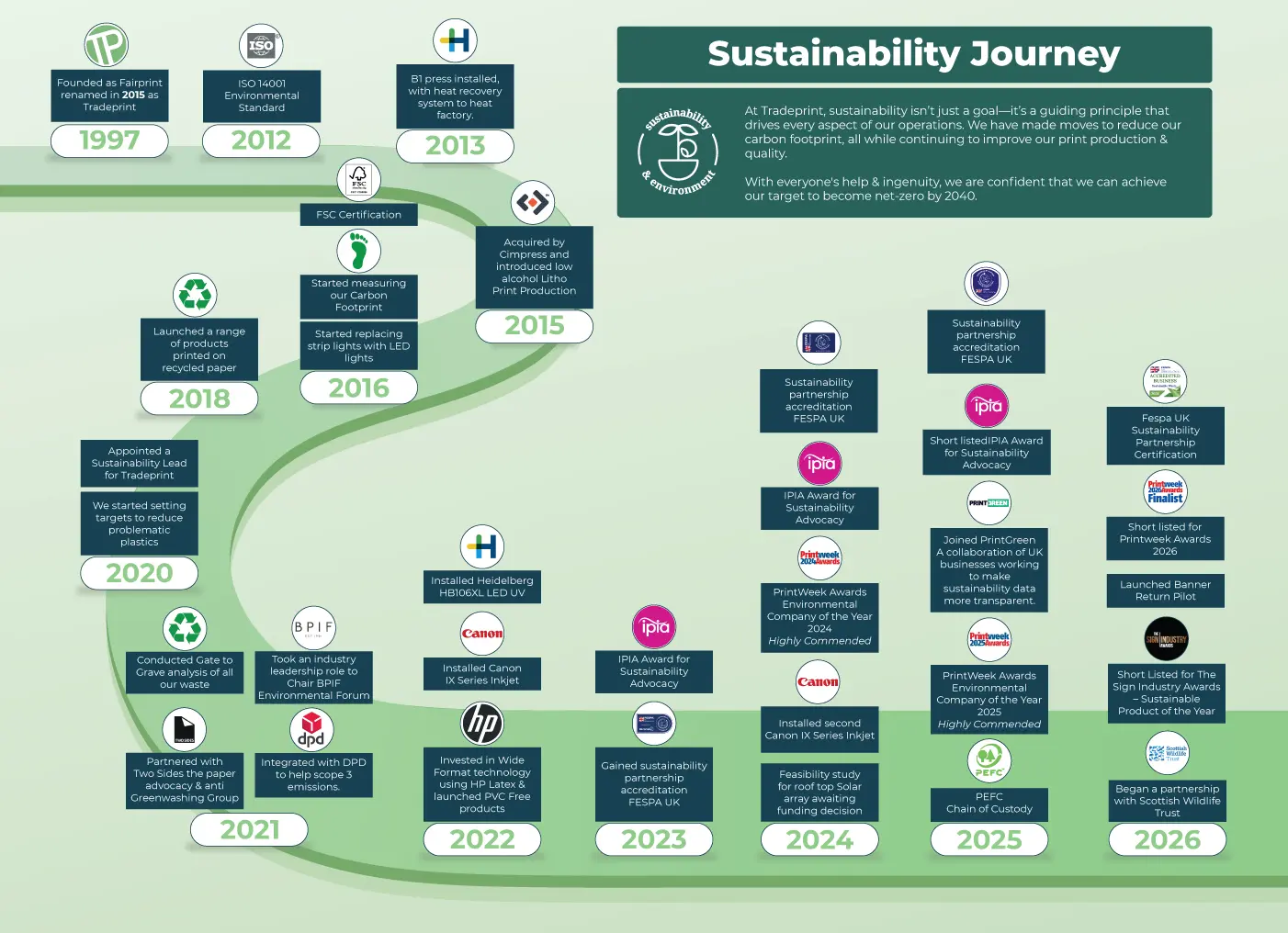
Sustainability Journey
Our company has undertaken a comprehensive review of our sustainability endeavors spanning the past few years. During this period, we have undertaken significant transformations in our infrastructure to lower energy consumption while enhancing our recycling initiatives.
We have also established partnerships with esteemed organisations specialising in sustainability, further bolstering our commitment to this vital cause.
CAPEX (Capital Expenditure)
The money spent by a company to buy, maintain, or improve long-term assets like buildings, equipment, or infrastructure.
Circularity / End-of-Life
Circularity refers to designing products and systems so materials can be reused or recycled. End-of-life means considering how a product is disposed of or recycled when it’s no longer useful.
Decarbonisation
The process of reducing carbon dioxide (CO2) emissions, typically by switching to renewable energy or improving energy efficiency.
DEFRA (Department for Environment, Food & Rural Affairs)
The UK government department responsible for environmental protection, agriculture, and sustainability.
Ecoinvent
A global database that provides environmental data to help assess the impact of products or services on the environment.
Emission Factors
Numbers used to estimate the amount of greenhouse gas emissions from different activities, like burning fuel or using electricity.
FSC (Forest Stewardship Council)
An organisation that certifies wood and paper products as being sourced from responsibly managed forests.
kWp (Kilowatt-peak)
A measurement of the maximum power a solar panel or system can produce under ideal conditions.
Lifecycle Analysis Tool
A tool used to evaluate the environmental impact of a product throughout its entire lifecycle, from raw material extraction to disposal.
Net Zero
A state where the total greenhouse gases produced by a company or organisation are equal to those removed from the atmosphere.
PEFC (Programme for the Endorsement of Forest Certification)
A global certification system ensuring that wood and paper products come from sustainably managed forests.
Project Hulk
Because it’s Big and it’s ‘Green’! a Cimpress initiative to promote the transition away from the use of problematic plastics.
Renewable Energy Certificates (REC/GO or REGO)
Official documents that prove electricity was generated from renewable sources like wind or solar.
Scope 1
Direct greenhouse gas emissions from company-owned or controlled sources, like fuel combustion in vehicles.
Scope 2
Indirect greenhouse gas emissions from the production of purchased electricity, heating, or cooling.
Scope 3
All other indirect emissions that occur in a company’s value chain, such as those from suppliers or customers.
Sustainable Forestry
Managing forests to ensure they provide environmental, social, and economic benefits now and in the future.
Waste Hierarchy
A system ranking waste management options from most to least environmentally friendly, typically starting with reducing waste, then reusing, recycling, and finally disposal.